1941 · THE AUSTRALIANS’ ESCAPE FROM PILI
For years we searched books, archives and old magazines to learn what our village lived through in the hard years of the war, and we found something few of us knew: the name of Pili appears in the archives of the Australian War Memorial, in books by Australian historians and in the reports of a secret American mission. We have gathered these pieces into four short stories, as faithfully as we could, with the sources at the end of each article.
Series “Pili in the Second World War” · Part 1 / 4
Spring 1941. The Germans are advancing through Greece, and in the Pineios valley, on 18 April, the Australian 2/2nd Infantry Battalion holds on for as long as it can so the Allies have time to withdraw. Its commander, Lieutenant Colonel Fred Chilton, is cut off and escapes into the nearby mountains to avoid capture. There Sergeant Smith, Corporal Brown and Corporal Hiddins join him.
As the Australian War Memorial writes, the battalion’s stand at the Pineios delayed the Germans and allowed the main Allied force to withdraw further south. Out of ammunition and surrounded, the men scattered into the hills in small groups. Chilton himself later wrote that their fight achieved its purpose: to delay the German advance towards Larissa.
Chilton’s group heads for the east coast, hoping to find a boat to Crete. They could only walk at night, because of the German motorcycle patrols. English-speaking Greeks advised them to cross to Evia, and a fisherman took them over. There they learned that the islands as far as Crete were already under German occupation, and they decided to cross the Aegean to neutral Turkey. So they found their way here, to our Pili: a village built in the forest, far from the road, where the Germans could not easily patrol.
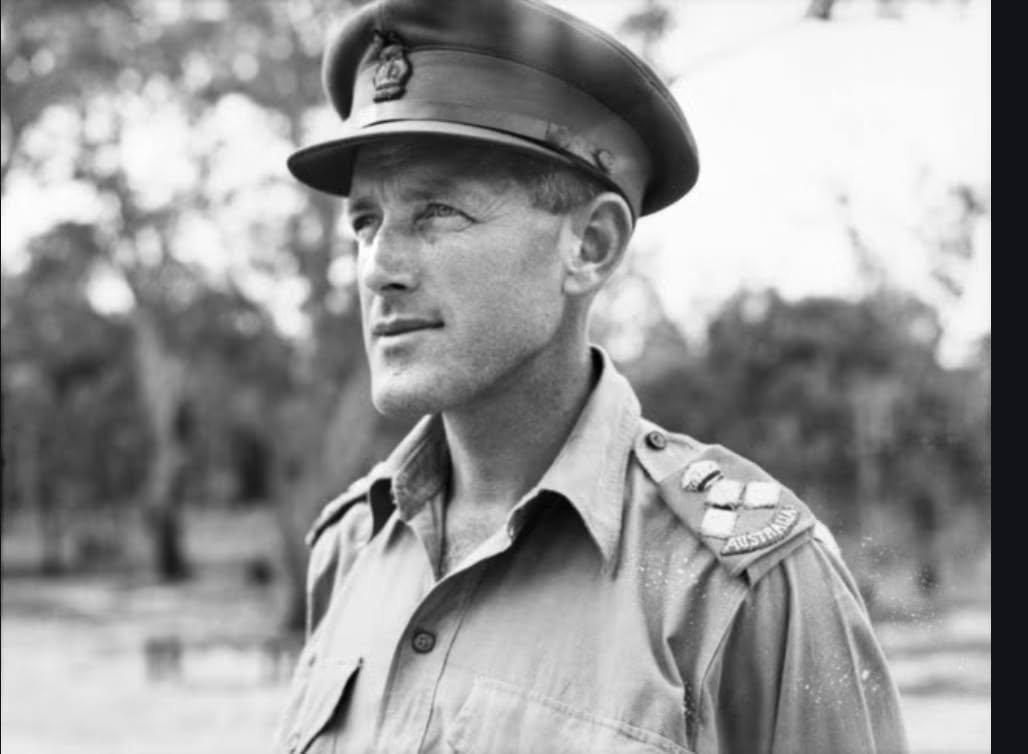
In Pili two people opened their door to them, two people Chilton never forgot: Moraitis, the manager of the magnesite mine, and Giannis Mourtzakis, the foreman. He called them “two splendid Greeks”. Moraitis was educated and spoke French; Giannis spoke a little English, as the mine belonged to British interests. By day the Australians hid in Moraitis’s house and by night in the caves above the village. There Chilton found more officers from his battalion.
One of the groups that reached Evia was led by Captain Bruce Brock, also of the 2/2nd Battalion. Brock usually went into the villages first, and the villagers, though often poor, shared whatever they had with them, even though they knew the risk. A man from Evia gave him a flint-and-tinder rope lighter, the kind shepherds carried. The lighter is kept today at the Australian War Memorial in Canberra. On Evia Brock’s men joined Chilton’s group, and in the photo near Pili we see them all together.
Read about the magnesite mine: Magnesite
The hardest part was finding a boat. Most people lived from their boats and did not want to risk losing them. Moraitis and Giannis Mourtzakis helped them search, and Chilton negotiated in French, because Moraitis and his friends did not speak English. In the end one man, for the little money the soldiers had and the promise of a reward from the British consul in Turkey, agreed to take them all in his small boat.
On the evening before they left the island, 8 May 1941, the photo you see was taken: Chilton with officers and men of the 2/2nd Battalion near Pili. Through Turkey, they eventually rejoined the Australian forces.
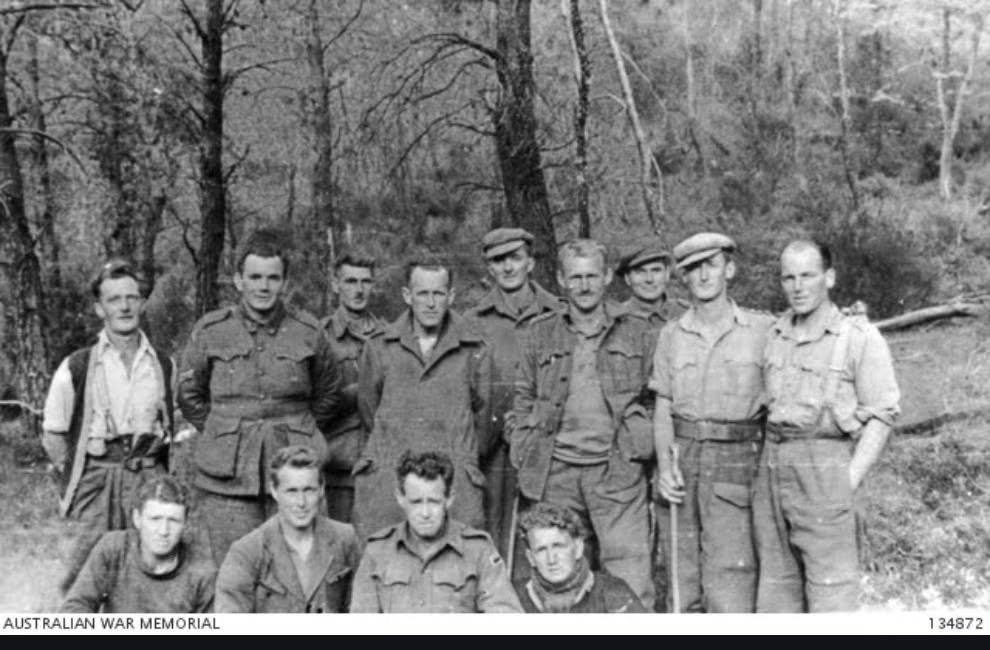
Alongside Chilton in the photograph are three officers from New South Wales who had joined his party on Evia in early May: Captain Charles Hercules Green, a farmer from Ulmarra; Captain Brock, born in Darwin and a teacher from Woonona; and Lieutenant Bosgard, a former bank clerk from Mosman. The photograph was taken just as they were about to leave for Smyrna.
Evia, the road to freedom
Pili was not the only refuge. Evia became one of the main escape routes for Allied soldiers. Its great size, its closeness to the mainland and the difficult terrain of its southern half meant the Germans rarely came. And once across the island, its eastern shores opened the way to the Aegean, Turkey, the Mediterranean and freedom.
These routes became known as the ‘caique runs’, after the traditional fishing boats of Greece. Caiques sailed from ports all over the country, from Mount Athos in the north to the Peloponnese in the south, carrying Allied soldiers to freedom. Thanks to the success of these voyages, the Allies later came back with supplies and agents to help the Greek Resistance. Evia was a key link on this road.
One account of these crossings comes from Felicia Leonardos, who lives in Melbourne. Her father, Stamatios Katsatos from Almiropotamos in southern Evia, was 35 when Greece fell. He was a furniture maker, but the war ended his trade and he turned to fishing with his friends Kostas and Angelos. When he was asked to ferry Allied soldiers from the mainland to Evia, he did not hesitate. As his daughter remembers, they brought the soldiers to Styra, on the island’s southern coast. There the men were dressed in local clothes for the rest of the journey, and crossed the island by donkey to the eastern coast, where other fishing boats took them out to sea to meet larger vessels.
One of the Australians who took this road was Warrant Officer Boulter, a lawyer from Frankston. Captured at Kalamata on 29 April 1941, he escaped during the march north to Lamia. Helped by villagers, he reached the coast with four others on 22 June, and a fisherman ferried him across to Evia. The hospitality of the Evians was such that his comrades decided to stay on the island; sitting with the villagers, they heard on the BBC that Germany had invaded the Soviet Union. Boulter went on to the east coast, where the bishop and priests of a monastery took him in and arranged for a fisherman to take him to Skyros. He reached Smyrna on 25 July, after three days at sea.
In the winter of 1942, Lieutenant Derbyshire, a former motor trimmer from Wagga, reached Evia with ten other Allied soldiers. He had escaped from a prison camp near Athens, fought alongside the Greek Resistance and seen for himself the suffering of civilians under the occupation, “men, women and little children starving to death”. Like the others, he reached freedom in the boat of an Evian fisherman from the east coast.
All this happened in spite of the occupiers’ reprisals. When a woman on Evia was told that the Germans had burned her house, she answered: “It doesn’t matter so much now. It’s warm and we can live in the open.” As one Australian put it, “the real heroes of the Greek war of resistance were the common people”.
But the story did not end there. The friendship born in Pili in those days lasted a lifetime.